
TL;DR Below are some of my thoughts about possible response card designs and applications
Initial Thoughts
To summarise, response cards (RC) are small, paper or cardboard-based tools that students can use in the classroom to share their response to a question, usually of a multiple choice or true/false format. They’re a step above the traditional hands-up approach to student participation (to which generally only a few students respond), and on a similar level to digital quizzing tools such as Socrative or Kahoot.
I view RC as having two key educational purposes: increasing student participation and engagement; and quick formative assessment of student understanding.
The cards themselves are relatively easy to use and require no student setup or Internet access. What I’m most interested in and want to focus on in this post are all of the different design and usage possibilities. The ways in which RC are created can influence their durability, usability and functionality.
In terms of durability, I would strongly suggest using cardboard or index cards as the base materials (coloured preferable), and laminating them to further strengthen them. Usability wise, I would advise that they remain small and easily held in one hand. Students responses are usually indicated using a pinch-method (students use two fingers to pinch the option they want to select) or some other external tool like a clothespin. For long-term use, it may also be worth bundling different types of response cards together using string or clips.
With all that said, let’s explore a few different question types and possible design choices for RC (see QuestionPro for an extensive rundown of question types).
Question Type 1: Yes/No
Also known as dichotomous questions, this question type is one of the most basic forms students will encounter in the classroom. I will also include True/False here for simplicity.
For these kinds of questions, it’s almost unnecessary to use response cards (you could use thumbs up/down for example). I suggest using more complicated RC designs (such as those for multiple choice) and making two of the options Yes and No when necessary. Nonetheless, below is a possible design suggestion if you want an RC dedicated for Yes/No.
Perhaps what you could do is have a long card strip, where the card transitions from green on one end, to yellow in the middle, then red at the other end.

Note that this is different to an RC that was split 50/50 green and red. If you want to go with this simple design choice, I would recommend making one side of an RC green, and the other red (this is what I have personally used in the classroom to mixed success).
The design above can be made simpler (and more practical) by having discrete colour changes (green, lime, yellow, orange, and red fifths).

My intention with this design is to suggest that rather than having a binary Yes/No RC, you can have a card that allows students to convey their level of confidence in a particular answer.
For example, students who are not 100% confident in answering yes may pinch the lime part of the RC rather than the green end of the RC. Students who are unsure either way can pinch the yellow middle of the RC.
This design can also be used after an explanation to determine students’ level of understanding (green for confident, yellow for unsure, red for “I need help!”).
Question Type 2: Multiple Choice
Multiple choice questions are a staple of classroom tests and quizzes. The questions themselves may contain one or more correct answers, but usually there are four to five options available. For practicality, I will consider RC with four options.
There are a couple of common designs available that allow for multiple choice responses. In each of them, I would advise that different colours be used for each option so that students and the teacher have an easier time identifying which option is which.
The first design is to split a long card strip into 4 sections, then label each section A, B, C and D.

The second design would be to use a squarish card piece and to split it four corners, then labelling appropriately. I prefer to use the first design, as they are slightly easier to handle.
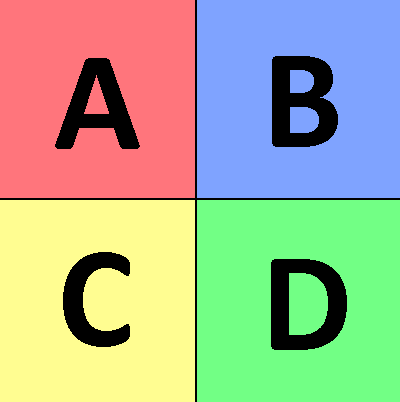
It’s a good idea to ensure that the RC is double-sided, with the back side matching the front. This allows students to see what part of the card they are pinching as they are holding them up for the teacher.
The colours can also be varied, e.g. Red – Orange – Yellow – Green, to have a confidence meter similar to the one discussed in Question Type 1.
Question Type 3: Rank Order
From what I have seen online, the first two question types that I have presented are the most common formats in which RC are used for. I believe this is partly the case because they are simple for students to use and easy for the teacher to interpret. I am still considering whether the next couple designs would be practical for the classroom, but I will share them anyways.
Rank Order questions require students to rearrange a series of options into a specific order. This could be done to express preference, or for sequencing purposes (e.g. ascending or descending order, chronological order).
I propose the following design: have a blank card strip, and four separated cards. From this, the cards can be attached to the card strip (in any order) using either Blu-Tac or Velcro, or by having card sleeves that the small cards can be inserted into.
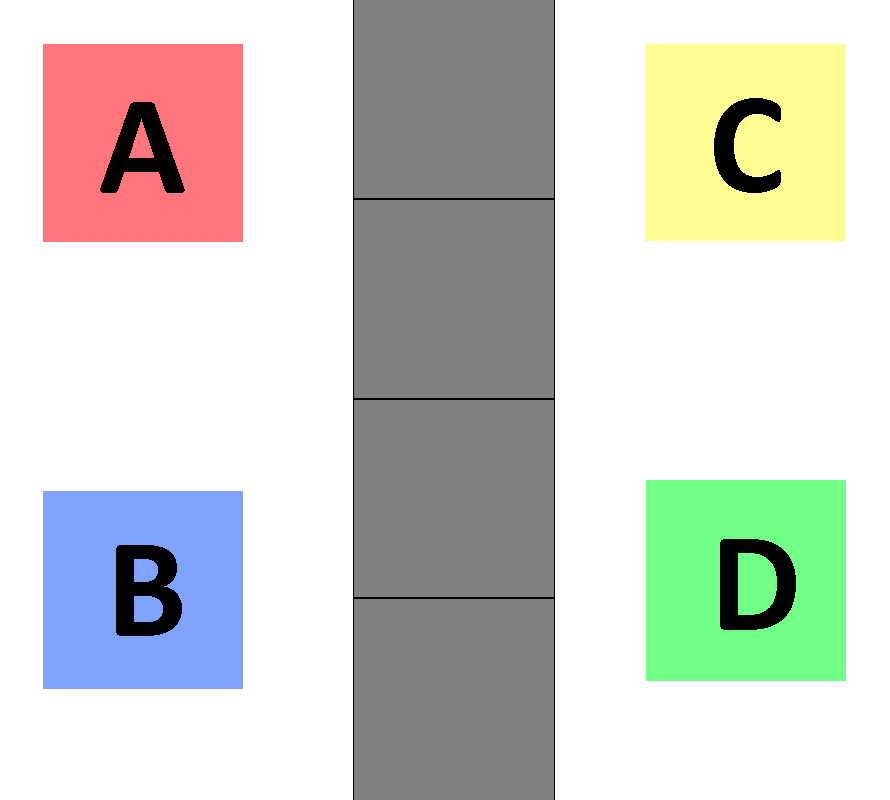
For broader application, I would suggest having A, B, C and D (or 1, 2, 3 and 4) cards rather than specific answers. A whiteboard or projector can then be used to display what answers each option corresponds with.
Additionally, depending on the question asked, consideration should be given towards whether the RC should be held vertically or horizontally. I believe that vertically works better for ranking or ascending/descending order, while horizontally works for sequencing (feel free to experiment with this).
These would be more difficult to prepare and use, but would also open up more possibilities in terms of the types of questions you can ask. For example, you could provide students with 4 organisms that they have to rearrange into a food chain (from producer to apex predator).
Question Type 4: Constant Sum
Constant Sum type questions would be best explained with an example:
Imagine a student has a $100 budget to spend on Bills (e.g. groceries), Entertainment (e.g. movies, sports) and Other Expenses (e.g. shopping) for the month.
Students are asked to allocate a proportion of their $100 to each category.
For example, a student might choose to dedicate $50 on Bills, $20 on Entertainment, and $30 on Other Expenses.
In terms of RC, I propose that these types of questions can be answered using a simple RC and some form of indicators. These could include small rubber bands, string, paper clips or dry erase markers (if the RC is laminated). Given a constant sum value, students would divide their RC using the indicator, similar to a divided bar chart.

Using the example above, the student could wrap a rubber band around the 50, then one at about 70. This would divide the card into 3 sections, where Bills takes up half the RC, Entertainment is allocated 20% of the card, and Other Expenses are represented using the remaining 30% of the card.
I think that these would be very difficult to effectively implement in the classroom, especially in terms of interpreting each student’s response, but I think it is still worth exploring. If not as a RC, then as an alternate way to create divided bar charts.
Additional Stuff
- If same-sidedness back-to-front is not desired, you can combine different RC designs onto one card strip. For example, on one side of a long card strip you can have multiple choice options, with the separation between markers representing the quartiles. The colour of each section can also double up as a confidence meter (e.g. red for 100% confident to yellow for 0% confident). On the other side of the long card strip, you can have Velcro for students to stick small cards onto for ranking questions.
- Rating Scale responses can be obtained using either the colour gradient RC (seen in Question Type 1) or the long card strip design (seen in Question Type 2).
- If the finiteness of resources does not concern you, I would also consider the possibility of printing out images. For example, you could have a blank squarish RC design with space to stick small cards on (e.g. 9 cards). Combined with a set of cards (e.g. elements of the Periodic table), this could be used to ask simple questions in Chemistry, such as which of the elements are non-metals, or which of them are gases at room temperature.
This kind of application would go against the RC design principle that they should be quick to use and easy to interpret, but would be interesting. Perhaps apply this in table group settings rather than individual-based, and include opportunities to allow groups to explain their responses in a classroom discussion setting. - An alternate RC design could involve the separation of the available options into individual cards (e.g. one card for A, another for B, and so on). This may be easier to use, but would require more resources and time to create for minimal gains in readability.
Final Thoughts
When it comes to the design of RC, it’s important to consider their functionality both for students and the teacher. For students, the RC should not be so complicated that they cannot quickly or easily use them to share their response. The teacher should also be able to easily gauge student understanding by glancing around the classroom at students’ responses. Ideally, the teacher shouldn’t have to spend more than a couple seconds trying to interpret what response students have given.
I personally believe that RC are useful as participation and formative assessment tools, but are limited in the kinds of responses you can obtain from students. If you wish to get a wider range of answers, or more individualised responses, I would suggest using mini-whiteboards. They’re a bit more costly in terms of resources (and can be more painful to clean up and pack away), but they create more opportunities for students to express their creativity and thought processes when responding to questions, compared to using RC.
I’ll be posting the next set of resources that I thought were interesting soon. Currently, I am in the process of collecting and reviewing resources from different sub-strands.
 STEM Vault