
Before delving into the list of resources I have extracted from programs covering the Computation with Integer substrand, here are my final(ish) notes:
- Videos where other teachers are explaining a concept or procedure were common – I feel that this is a missed opportunity for teachers to explain the concept themselves or have students actively involved in the learning process
- Online games that were included were mostly fluency focused and not effective for teaching about conceptual understanding – they also tended to be of low quality or overly distracting from the mathematical learning
- Worksheets where there were lots of similar problems were also common – they were also fluency focused and had the potential to turn students off mathematics (would discourage their use in favour of more well-rounded worksheets)
- Kahoot quizzes – just terrible
With that all said, here are some resources that I felt could be useful for teaching. If nothing else, they are worth looking at for ideas.
Stage 3: Multiplication

http://www.ictgames.co.uk/ – Specifically, the Array Display Mathematics Teaching Tool (requires some navigating of the website)
- Demonstrates how multiplication and division can be visually represented using arrays (could use counters)
- Includes features for showing commutativity and how multiplication and division are inverse operations of each other

https://www.kenkenpuzzle.com/game – KenKen Puzzles, developed in 2004 by Japanese mathematics teacher Tetsuya Miyamoto
- Fun, customisable puzzle activity that involves computation with integers
- Can change the size of the puzzle, the number of operations included, and the difficulty of the puzzle
Math Games: Using Dice With Kids Aged 8-13 by Jennifer Hogan
- Factor Dice – could be modified to require addition rather than multiplication (this would open up more possibilities for prime numbers), overall simple but effective for practising factor pairs
- Multiple Dice – basic game for multiples, basically just generating numbers
- Multiplication Dice War – not much going for it (basically just roll to win)
- Multi-Step Dice – variability in operations makes the game interesting, should add an end goal/victory condition
- Fraction Dice – basic but interesting game for creating and ordering fractions on a number line

https://calculator-1.com/ – Basic Online Calculator
- I would use this to demonstrate on a projector how to perform basic calculations (which buttons should be pressed and in what order)
- Alternatives exist, e.g. the CASIO calculator emulators – these would be more useful for students as it will more closely match what they will be using

Multiplication Mania Desmos Activity, created by Alisha Zare
- Designed for Year 4 students, the activity provides contextual variety to its problems
- Of particular interest is the final task where students match the arrays with the appropriate multiplication statement – may be interesting to adapt it using physical materials
https://www.webwhiteboard.com/ – Web Whiteboard
- Basic functionality – pens, text, images, comments
- Could be potentially useful for student collaboration – can also download pictures of the whiteboard as evidence of student work
Stage 4: Computation with Integers – Positive Integers Only
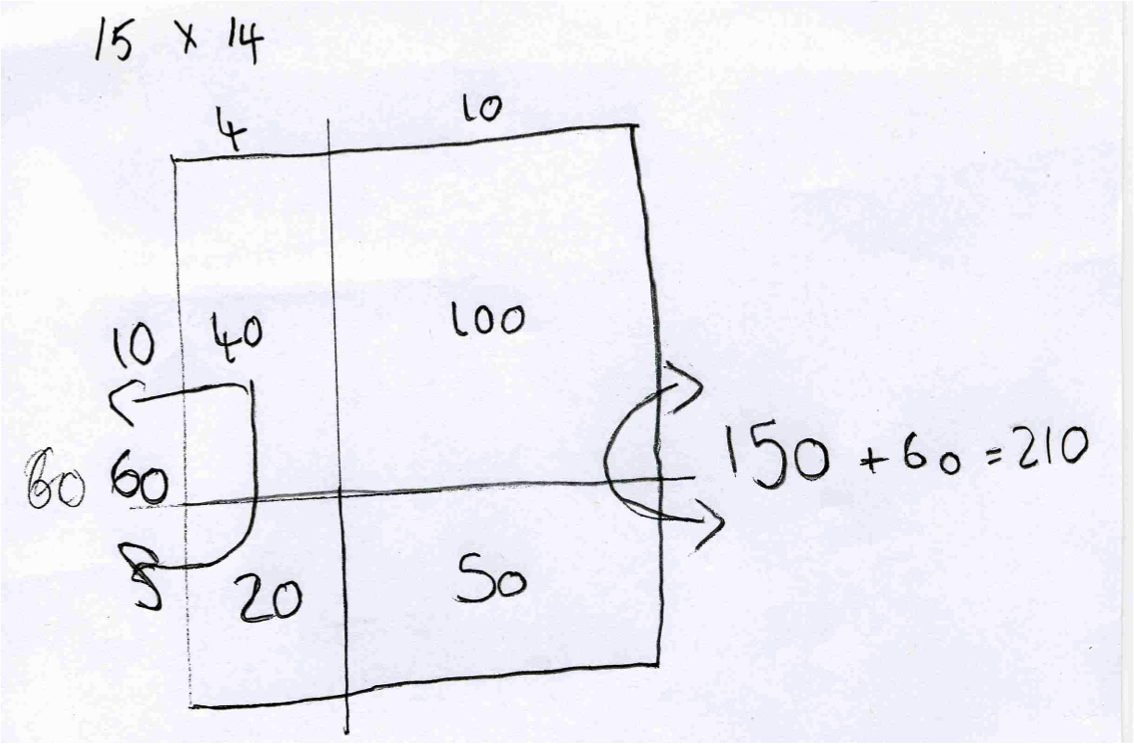
https://nrich.maths.org/2466, https://nrich.maths.org/2469 and https://nrich.maths.org/8773 – NRICH Articles about Multiplication and Arrays
- These articles detail how arrays can be used to visually model multiplication and division
- Arrays can be useful for visually justifying how complex multiplication can be simplified (e.g. 15 x 14 into 4 x 10 + 10 x 10 + 4 x 5 + 10 x 5)
Math Games For Kids: The Math Operations Game by expertvillage
- Basic game – requires creating paper cards (0 to 9 and basic operations)
- Three numbers and two operations are drawn – the goal is to use the drawn cards to create the largest number (12 combinations possible, could explore all of them)
Simplifying Expressions Worksheet found on Zili Yang’s Unit of Work
- A basic worksheet format that gets students to step-by-step simplify different expressions, and to identify which operation they are using in each step
- The format is easily to recreate, but should not be used excessively
Pattern Block Activity, found on Zili Yang’s Unit of Work
- I would try to recreate this using physical pattern blocks (or cutouts if unavailable) – would be less finicky
- Blocks and area are used here to represent fractions – other shapes could be used, but hexagons allow for clean halves, thirds, quarters and sixths
Stage 4: Computation with Integers – Introduction to Integers
Opposite Instructions by PBS LearningMedia
- Simple game focused on opposite numbers (positive and negative)
- It should be noted that the game considers the ‘smaller’ number to be the one most to the left of the number line, rather than closer to 0 (magnitude)
Adding Integers – Middle School Math Puzzle (1 of 4) by Amy Harrison
- Tarsia puzzle – would use at the start of a lesson to engage students
- Can be created yourself using this software (requires some getting used to, should ensure the final puzzle is readable)

Plus Minus Game by Deceptively Educational
- Deceptively Educational has a collection of educational games that I strongly recommend to browse through
- The Plus Minus Game can be used for practising multiplication of positive and negative numbers

https://quizizz.com/ – Quizizz
- Can explore all of the premade Mathematics quizzes or create your own (quality can greatly vary, would recommend creating yourself)
- Students can quickly join a game hosted by the teacher, and the results can be used to informally assess their progress or understanding
 STEM Vault