
Interesting Mathematics
- National Curve Bank: A repository of curves, maintained by the California State University’s Department of Mathematics. Example: Vector Fields, Möbius Strip, Waldman’s Heart.
- The On-Line Encyclopedia of Integer Sequences: A digital database of integer sequences – you can search for famous sequences by name, or you can try entering a sequence of numbers to see if it is catalogued. Each sequence in the OEIS can be represented in different ways (e.g. list, graph) for your viewing. They are also accompanied by comments and references for further exploration.

- The Most Common Errors in Undergraduate Mathematics: A summary (and commentary) of the most common errors made by undergraduate mathematicians (although they also often apply to secondary students too). Some examples include: Bad Handwriting, Sign Errors, Everything is Additive, and Undistributed Cancellations.
- Some Fundamental Theorems in Mathematics: Oliver Knill’s compilation of 243 fundamental mathematics theorems. Of particular interest (or familiarity) are Theorems: 1-5, 8-10, 16, 29-30, 42, 55, 63, 65, 124, 140, 160, and 193.
- Proof Wiki: “An online compendium of mathematical proofs!” Proof Wiki also keeps records of mathematical propositions, theorems, facts, and fallacies. For example, visit Proof Wiki’s articles about Circle Theorems.
- The House of Graphs: Want to search for all the graphs that fit certain conditions, e.g. 10 vertices, 15 edges, and connected? Use the House of Graphs as a directory for finding such graphs (search for one condition first, then add conditions to refine your search). Challenge: find all the unique simple graphs with four vertices.
- KnotInfo: A database of knots – I’ve included it here in case you want to give students some novelty, e.g. the trefoil knot. You can also discuss the history of famous knots, e.g. the Gordian Knot, or teach students how to form different knots.
- Open Logic Project: An open-source textbook for logic, from the basics to the highly advanced. You can also download individual textbooks, e.g. Sets, Logic, Computation.
- Math Fun Facts: Mathematical fun facts, mostly designed for college students, although you could also (probably) show these to curious senior high school students to spark some further interest in mathematics. Popular facts from the website include: Napoleon’s Theorem (regarding equilateral triangles) and Brouwer’s Fixed Point Theorem (see: Vsauce’s video about Fixed Points).
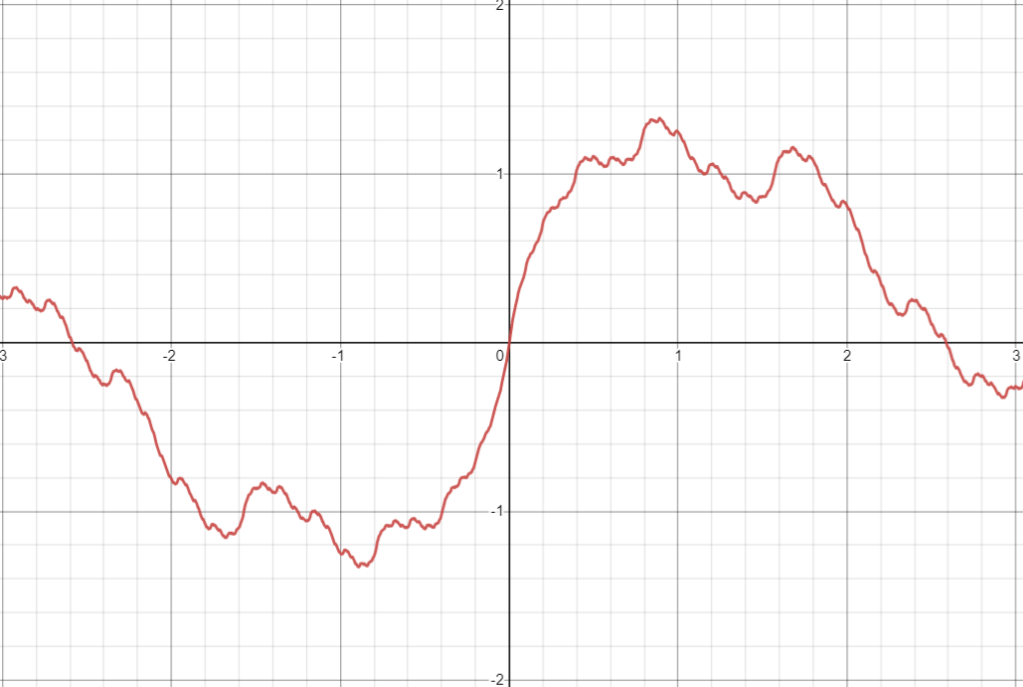
- Weierstrass Functions: Weierstrass functions are continuous everywhere, but differentiable nowhere – they exhibit fractal-like properties when you try to zoom into the graph of Weierstrass functions (theoretically, at least – can’t zoom in forever on computers).
- Pascal’s Triangle: Various properties (with accompanying diagrams) of Pascal’s Triangle. You’ll likely teach students about the triangle’s relationship to binomial expansion – before that though, it might be of interest to your students to show them, e.g. the hockey stick pattern.
- Notes on Math Proof: A general set of notes about mathematical proofs, including an introduction to logical connectives, proof by contradiction, and proof by induction.
- The Great Internet Mersenne Prime Search: Are you interested in mathematical glory? Do you tend to keep your computer on while away? Consider joining the hunt for the next Mersenne prime, i.e. primes of the form 2p – 1 where p is a prime number. To date, only 51 Mersenne primes have been discovered. Learn more about the history of the project here.

- Parabola: Secondary mathematics level magazine published by the University of New South Wales since 1964. UNSW’s School of Mathematics and Statistics also runs an annual School Mathematics Competition, with past questions available here.
- Plus Magazine: Another mathematics magazine, published by the University of Cambridge since 1997. Plus also produces podcasts, e.g. The Maths and Magic of Shuffling.
- The Map of Mathematics: Each area of mathematics presented is companied either with an interesting animation or images, interactive element, or related stories published by Quanta Magazine, e.g. The Riemann Zeta Function.
- Eureka Magazine: Digital archive of Eureka, a recreational mathematics magazine that has been published by Cambridge University’s mathematics society (The Archimedeans) since 1939.
Previous Page: Mathematics Lessons and Activities
Next (Final) Page: Digital Tools and Data
 STEM Vault